Showing posts with label patchwork. Show all posts

Thursday, November 25, 2010

Imaginarium, a Scrap Baby Quilt

Imaginarium, a charm quilt for baby

This is a baby quilt, made from leftovers from a quilt which I am making for myself.  It is a little fancier than most charm quilts.  Charm quilts are named for their 'charm' because they are made from scraps which sometimes do and sometimes do not blend well.  Charm quilts tend to be more funky and campy than their sister-quilts-- matched piece quilts.  A unique feature of this quilt is that it has some of the prairie points and flat trim from the big quilt, and it adds interest and detail. 

There are some jokes or funny parts to this quilt that will make you laugh if you're a quilter.  I'll let ya in on the secret.  A beginner quilter might make borders such as the stripe and print here, and might attach one edge backward or going to same direction as the other side as I have done.  Experienced quilters would never do that because it violates the rules of symmetry.  However, Fluffy I am and Fluffy I do, so here the borders on both sides are going in the same direction.   It was a conscious choice. 

Another quilter's joke is that in places you'll find prairie points or flat trim, and not in other places that one would expect to see the same thing.  So happens that I made up some extra length of these and attached them to sashing, only to destine them to the cutting-room floor. 

Here I have followed the old legal maxim of equity, known to law students throughout time from Black's Law Dictionary (or Prosser on Torts) "You take your victim as you find him."  In law, it means that a tort defendant is liable for the outcome even if a tort Plaintiff or victim is extraordinarily impacted.  If you trip a waiter with brittle bones simply in revenge because of poor service, you must pay the price of the damage you do, even if an average waiter would not suffer greatly from being tripped.  Likewise, I've 'taken my victim as I found him' in my scrap pile.  Some strips with Prairie Points don't have a full row.  Well, tough cookies.    My goal was to quilt up that mess in the floor.  The result is that you have a few unexpected things happening on this quilt.

This juvenile quilt top is for sale as a top ($100) or fully custom machine quilted, batted and backed with the contrast or match fabric of your choice ($300).    

Monday, April 19, 2010

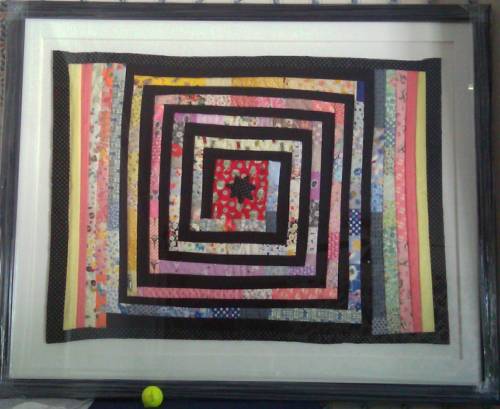
Depression Era Wall Quilt, Framed


I made this textile piece for Salina Clinic, and it is framed by NDN Art Gallery in Tahlequah, Oklahoma.  Remember those wonderful aprons you might have seen your grandmother wearing when she was haning out clothes on the clothesline?  My grandmother, Lizzie Carter, had one that had big pickets and contrasting piping, and it had a bib front with a button or sash in the back.  Some of those were made from flour sacks.  Back then, in the days before carry-out food, women cooked every meal at home and men would sometimes carry a lunch pail or come home for lunch.  People mostly lived on garden goods which they grew themselves.  My grandmother lived near the peddler man whose house was on Lee Street.  He would come around in a cart drawn by a horse or horses, with a load of produce on the back in a cart, and right there at your home you could pick out some great food grown fresh, to fix for the next few meals.  My memories are from the 1960s in Tahlequah Oklahoma, but my father Gene Carter remembers earlier days.  Women would buy bulk flour and sugar in big sacks about the size of a pillowcase, and they'd rip the seam open, to make a yard of material.  At the store you could choose which fabric sack you wanted, and women would save them up for sewing a dress, apron, shirt or quilt.  Flour sack quilts and yard goods in the 1930s were bright and colorful--- social historians say that folks wanted bright colors because the economy made their lives drab.  But I don't think life was that drab.  Earlier colors were, though--- the dark and sad shades of the nineteen twenties and teens gave way to these bright colors, about when new dyestuffs and chemistry were being innovated.  An earlier blog featured "Trip Around The World" variation quilt--- one in my collection of antique quilts.  This little quilt is a miniature abstract variation on that vintage quilt, and it features authentic reproduction fabrics documented for that same time period.  Not all of these designs were flour or feed sack or cornmeal sacks.  Some were yard goods of the time.  Back then, bolts were usually 28 inches wide in cotton, and printed using a roller method on one side of the fabric.

This mini was made by stripping reproduction fabrics then turning the "stripes" sideways and making each one into a square... or often a rectangle.  Then I used black to pair the postagestamp blocks into one-inch blocks (approximately) and pieced them like a log cabin, only in reverse.  The resulting optical effect is a spiral moving from the center, outward, clockwise like the passage of time.  In the middle is a Cherokee Star.  That's a golf ball at the bottom.  It was phtographed behind a golf ball, sort of by accident.


This peice is spoken-for and will be acquired by Cherokee Nation Entertainment.  Cherokee Nation passed a law allocating a percentage of each building's construction budget for the purchase of original Cherokee art for the building decor.  That's a wonderful law because it keeps artists fed, and keeps the arts communital in vitality.  Thanks to Cherokee Nation and CNE for buying this textile art.

Wednesday, March 31, 2010

1970s Crazy Quilt


1970s Crazy Quilt

I think this 1970s Crazy Quilt was made by my former Mother In Law, Ruby Thompson of California and Oklahoma.  It is a utility quilt, with wide bright velvet top panels and some funky red and blue herrigbone houndstooth wool and some chartreuse fabric along the side panels.  It is a tack quilt-- a common quilting style for casual home quilts that were designed for warmth and to hold down the covers.  It is heavy and the backing is hemp or linen in cream with about an inch-wide binding edge.

Look close, and you can see that it was constructed by sewing five panels of varying widths together vertically.  Each panel was first made up of some foundation blocks.  This one is constructed with so much asymmetry that it is almost possible to understand the order in which each piece was added.  We know from the seams further toward the top that the Red V panel and the Black Brick panel were sewn together before adding the Burgundy/Gold panel, and the edges at top and sides were added thereafter.  (Actually, this is photographed with the bottom of the quilt at the top of the pic--- it was made probably for a small bed and the borders were intended to hang on the sides and foot of the bed.  I'm guessing it was intended to lay under the pillows, flat.)