Showing posts with label textiles. Show all posts

Monday, May 24, 2010

Cherokee Syllabary Cherry Silk Scarf


Here's an interesting new design.  I made this silk scarf using syllables from the Cherokee language.  I won a benefit auction for a used working Nacho Cheese heater, and converted it to a soy wax heater.  I keep the was there all of the time, and when I am planning to do soy wax resist batiking, I flip the switch.  Like a double-boiler the water heats the wax to a low melt, and I don't have to fiddle with the dangerous microwave in my utility room-slash-art studio.  I rarely work in reds, but was making a peppermint swirl tiedye tee for a custom order and had prepared the soy wax resist lettering in advance.  This is made using analine dyes of 3 blended shades of red, so it has shading and is not just a solid vat red.

Most of the clothes in stores is made from cloth which was vat-dyed.   The cloth goes thru a batch of dye and is highly agitated (although not mad ) in order to achieve a consistent monotone of color.  If you've a friend who tells the same joke over and over, you can appreciate how I feel about solid monotone colors.  It is just boring.  It is done because vat dyeing looks better when fabric is dyed before the clothing is constructed.  Or, only after clothing is constructed does nonvat dyeing "look right."  Basically, its easy, quick and cheap to vat dye... if you're doing millions of, ie, yards.

Much more time-consuming and thus expensive is anything ombred (ohm-burred) where the colors shift like watercolor, or tied and dyed as in tiedye and mudme.  This scarf was time-consuming because of making each syllable and its pronunciation.  (Not all Cherokee Syllables are there.  My chart shows 13 rows of 6 columns and some columns have 2 syllables as in Ga Ka and Dla Tla.).  The dyeing itself was rather simple compared to some dyes I use which are prepared with exotic stuff like inner bark, heartwood, fungus, bugs and the like.

This sweet cherry scarf is being listed at Island Retreat on etsy.  You will find a link on the right, perhaps to this very scarf if it is listed.

If you would like to receive notice when I post something new, subscribe to my rss feed and you'll get my blog as an email.

Friday, April 30, 2010

Sanskrit Gibberish Scarf

Soy Batik Silk Scarf

I can't write in sanskrit, so I just scribbled something that I thought seemed a little bit like sanskrit when I was doing the soy wax batik resist for this scarf.  Here's sort of a how-to:  Start with a silk scarf and prewash it.  I like to give mine a strong scrub in the washer, but avoid soap or detergent.  Let it dry flat or hanging.  Then it is ready for the resist.  "Resist" is a term used for making part of the fabric where it won't soak up any color.  You melt soy wax and apply it to the scarf.  Where ever the wax soaks in, it will keep the fibers from taking any color.  Next, apply alum.  I keep a batch of alum made up for this purpose and made mine a year ago, so I don't recall the recipe.  It can be looked-up online.  Allow your article to dry in the air.  You can see already that this process takes several days.  The next day, place your scarf in the dyepot.  For Rose Madder as in this one, I made up a dye batch several days ago.  I happened to leave it under the roof dripline and it got some rainwater in it.  Every item and every dyebath is different, so there is always a huge range of possibilities .... all of which are uncontrollable.... when you do this.  You can gently and slowly heat Rose Madder Root dye bath, but don't let it boil.  It should steam and simmer but not boil.  Boiling is very bad for silk.  When you've achieved the color you like, turn off the heat.  Next day it will have cooled, and you can squeeze the dye out of the scarf and hang up the scarf some place on a towel where it can get bone-dry.
  
By now, you're going to start seeing clumps of soy wax flaking off, but that is OK.  Now, for the ethical question:  Do you wash it in the washer in a lingerie bag, or hand wash it in the sink?  Either way, use hot water of about 140 degrees to melt the wax.  Choose to do this in the drain you would like to stopp upp.  I like to alternate, hoping that there's enough routine family traffic in those drains to avoid a bad plugging.  Allow your silk scarf to dry completely.  There are two alternative methods for the step of ironing away the remaining soy wax.  You could place the scarf between layers of tissue paper (white.... not purple) and iron on the silk setting.  Or you could gum up your iron anyway by not using paper to absorb the wax.  I use the latter method (having taken a vow of ironinglessness many years ago which I have faithfully kept).  But if you actually use your iron like an ironing person, then don't be like me.  Otherwise your spouse will have strange blobs of what only you know is soy wax on his shirt, and you'll feel remoreseful but never admit you done it.  This code of silence can damage even the strongest love----  I know.  Four husbands and I am still making mistakes.

Now your scarf should be colorfast, clean and ready to wear for some quirky adventure..... geocaching?  Time travel?  Visiting a client in jail?  Probably best not to wear such a scarf to jail, as it would make a fine hostage leash if things went badly.
This scarf is for sale, $18 and can be purchased by emailing ktibbits@lrec.org .  It will probably be available thru Oklahoma Food Cooperative and on etsy soon, so you might look for it in one of my shops by clicking on one of the images in the righthand margin of this blog page.


Monday, April 19, 2010

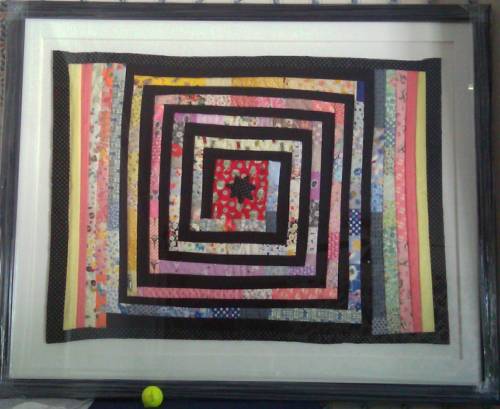
Depression Era Wall Quilt, Framed


I made this textile piece for Salina Clinic, and it is framed by NDN Art Gallery in Tahlequah, Oklahoma.  Remember those wonderful aprons you might have seen your grandmother wearing when she was haning out clothes on the clothesline?  My grandmother, Lizzie Carter, had one that had big pickets and contrasting piping, and it had a bib front with a button or sash in the back.  Some of those were made from flour sacks.  Back then, in the days before carry-out food, women cooked every meal at home and men would sometimes carry a lunch pail or come home for lunch.  People mostly lived on garden goods which they grew themselves.  My grandmother lived near the peddler man whose house was on Lee Street.  He would come around in a cart drawn by a horse or horses, with a load of produce on the back in a cart, and right there at your home you could pick out some great food grown fresh, to fix for the next few meals.  My memories are from the 1960s in Tahlequah Oklahoma, but my father Gene Carter remembers earlier days.  Women would buy bulk flour and sugar in big sacks about the size of a pillowcase, and they'd rip the seam open, to make a yard of material.  At the store you could choose which fabric sack you wanted, and women would save them up for sewing a dress, apron, shirt or quilt.  Flour sack quilts and yard goods in the 1930s were bright and colorful--- social historians say that folks wanted bright colors because the economy made their lives drab.  But I don't think life was that drab.  Earlier colors were, though--- the dark and sad shades of the nineteen twenties and teens gave way to these bright colors, about when new dyestuffs and chemistry were being innovated.  An earlier blog featured "Trip Around The World" variation quilt--- one in my collection of antique quilts.  This little quilt is a miniature abstract variation on that vintage quilt, and it features authentic reproduction fabrics documented for that same time period.  Not all of these designs were flour or feed sack or cornmeal sacks.  Some were yard goods of the time.  Back then, bolts were usually 28 inches wide in cotton, and printed using a roller method on one side of the fabric.

This mini was made by stripping reproduction fabrics then turning the "stripes" sideways and making each one into a square... or often a rectangle.  Then I used black to pair the postagestamp blocks into one-inch blocks (approximately) and pieced them like a log cabin, only in reverse.  The resulting optical effect is a spiral moving from the center, outward, clockwise like the passage of time.  In the middle is a Cherokee Star.  That's a golf ball at the bottom.  It was phtographed behind a golf ball, sort of by accident.


This peice is spoken-for and will be acquired by Cherokee Nation Entertainment.  Cherokee Nation passed a law allocating a percentage of each building's construction budget for the purchase of original Cherokee art for the building decor.  That's a wonderful law because it keeps artists fed, and keeps the arts communital in vitality.  Thanks to Cherokee Nation and CNE for buying this textile art.

Monday, March 29, 2010

1909 Charm Afghan

1909 Charm Afghan
Despite rumors that I was a little girl in 1909, this is not one of my creations.  This afghan was purchased.  Always ask when you buy an old textile item, because often you can keep the info about its history which adds an interesting factor.  This afghan was made by Berta Conklin Alteres, who was born in Fort Smith Arkansas.  She lived in Wagoner County Oklahoma, and this afghan was purchased in Wagoner or Cherokee County, Oklahoma in the 1990s.  I love the wool crocheted ruffle, although there are some raggedy places in it.

"Charm" textiles are made with scraps and surplus.  They tend to be less "patterny", more random and funkier than perfectly planned textiles.  I like to see the random or raucous color combinations.  It is a delight to see how women Skwooched things together to make them fit and become orderly despite limitations such as mixed quantities of different wool.  This one is all wool.  Crocheters will attest-- using wool takes more finger power than acrylic yards today.  Wools are dyed differently and take color less evenly than acrylic. 

The person who sold me this afghan thought it was made in about 1909.  But as usual, I have a red flag question.  One square is varigated, and I'm wondering if varigated commercial yarn was invented back then?  But maybe, it wasn't commercial yarn and Ms. Alteres or someone else dyed it ombre/varigated herself.